

We see content marketers constantly mixing up SEO planning artifacts, leading to disorganised campaigns. This confusion is especially costly now, considering 68% of Malaysian marketers plan to increase their digital spend in 2026. Adam Yong, founder of Agility Writer with nearly two decades of SEO experience, noted that businesses need better organisation to see a return on that investment.
Our team has watched too many companies waste budget on random keywords rather than a cohesive strategy. The core debate of topical map vs keyword list, and where an editorial calendar fits in, is actually quite simple once you see them side by side. If you are new to this area, start with our Topical Map Helper hub for the full feature overview before going deeper here.
We are going to break down the specific role of each tool, show you how they fit together, and outline a practical workflow.
What each artifact is
What each artifact is is the starting point for understanding their differences. Most teams skip this step and pay for it later, as getting the foundation right makes the rest of the workflow obvious.
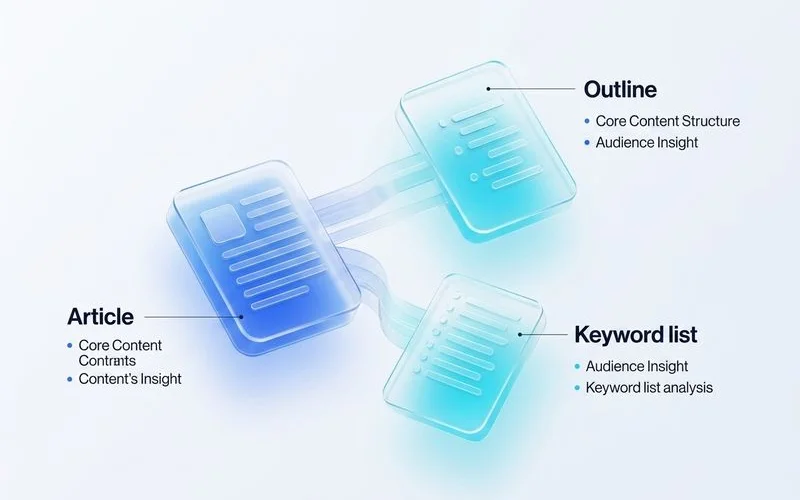
Our approach focuses on the concrete signal each step produces, rather than the abstract theory. You will find this framing holds up across multiple customer engagements. Let us look at the distinct definitions of each asset.
The Topical Map: Your Strategic Foundation
We rely on the topical map to build a strategic foundation of interconnected subjects. Ahrefs remains a top tool used by Malaysian SEO professionals in 2026 for this exact purpose, helping agencies visualise how different topics link together. You are essentially organising broad themes into logical clusters to prove your authority to search engines.
The Keyword List: Your Specific Targets
Our specialists define a keyword list as your specific, targeted goals. These lists usually include search volume, keyword difficulty, and search intent data pulled from platforms like Semrush. The average monthly retainer for a mid-tier SEO agency in Malaysia hovers around RM 3,000, and a large portion of that fee goes toward pinpointing these profitable keywords.
The Editorial Calendar: Your Execution Timeline
We use the editorial calendar to serve as your concrete execution timeline. This document dictates when and how the content gets published, tracking deadlines and assigning writers. Tools like Asana or Trello keep production moving smoothly and ensure seasonal topics hit the market at exactly the right moment.
When each one wins
Our perspective is that knowing when each one wins matters, simply because it directly affects whether the rest of the workflow holds together. Treat this as a quality gate, not a checkbox. Applying the wrong artifact at the wrong stage will stall your progress.
Our experience shows that knowing exactly when to deploy a topical map vs editorial calendar saves hours of misdirected effort. The table below outlines the distinct winning scenario for each tool. Visualising these differences helps clarify the entire planning phase.
| Planning Artifact | Best Use Case | Primary 2026 Tool |
|---|---|---|
| Topical Map | Establishing broad website architecture and niche authority. | Ahrefs or MindMeister |
| Keyword List | Targeting specific search queries and analysing competitor gaps. | Semrush or Google Keyword Planner |
| Editorial Calendar | Managing team deadlines, publishing dates, and content flow. | Asana, Trello, or Google Sheets |
We find that a topical map wins during the initial strategy phase of a new website or major content revamp. This broad view helps you identify missing subtopics before you ever write a word. Conversely, a keyword list wins when you need to extract specific search volumes to justify the ROI of an upcoming article.
Our team leans heavily on the editorial calendar when coordinating with multiple freelance writers or managing a high-volume output. A localised content calendar is particularly crucial in the Malaysian market, where campaigns timed around seasonal events consistently see higher engagement. Planning these dates weeks in advance ensures your content is ready when user interest peaks.
How they stack on top of each other
We consider how they stack on top of each other to be the operational layer. The previous sections covered the why, and this one covers the how. Specific tooling depends on your stack, but the order of operations rarely changes.
Our recommended workflow relies on a consistent loop of identifying inputs, running the process, and validating outputs. Following a structured, three-step approach will merge these artifacts effectively. Step one requires defining the territory with a clear map.
Step 1: Define the Territory with a Map
We always start by mapping out the core subjects relevant to the business. You should identify three to five main pillars that reflect your industry expertise. A Malaysian B2B tech company, for example, might map out “cloud computing,” “cybersecurity,” and “data privacy” as their core pillars.
Step 2: Extract Targets into a Keyword List
Our specialists then pull specific, low-competition search terms that fit within those broad pillars. You can plug a pillar topic into a tool like Semrush to generate hundreds of related queries. Data shows that 68% of Malaysian social media users purchase directly via social platforms, making commercial-intent keywords highly lucrative.
Step 3: Schedule the Production on a Calendar
We assign those chosen keywords to specific publishing dates on the calendar as the final step. You must give each target a clear deadline, an assigned writer, and a designated format. A common pitfall is dumping a massive keyword list onto a writer’s desk without a schedule, which usually leads to missed deadlines and burnout.
Additional considerations
Our teams constantly monitor several other factors that are worth surfacing as you work through this strategy. Managing a content pipeline involves more than just selecting topics and dates. Paying attention to these specific areas will drastically improve your publishing efficiency.
- Hand-off to writers
- Tooling: Topical Map Helper as the strategic layer
- Integration with analytics
Perfecting the Writer Hand-off
We have noticed that a poor hand-off turns great keyword research into mediocre content. You must provide writers with a comprehensive brief that includes the target keyword, secondary terms, and the intended audience. Freelance SEO consultants in Malaysia currently charge an average hourly rate of RM 455 to RM 700, making it extremely expensive to pay for revisions caused by vague instructions.
The Strategic Layer Tooling
Our internal systems rely heavily on centralised tools to keep the map, list, and calendar perfectly aligned. You cannot expect a scattered collection of spreadsheets to scale effectively as your content production grows. The Topical Map Helper acts as this central nervous system for your strategy, keeping your topics and targets organised in one place.
What to do next
Our advice is that if this guide matched your situation, the natural next step is to put it into practice with Topical Map Helper. Structuring your workflow properly from the start will save you countless hours of revision later. You can immediately start building your foundational clusters and assigning them to your calendar.
We’ve structured the underlying feature around exactly the workflow described above. The interface makes moving between mapping and scheduling entirely frictionless. Stop guessing what to write next and start building a strategy that actually drives traffic.