

Our founder, Adam Yong, spent nearly two decades managing campaigns before launching Agility Writer to solve major content bottlenecks. This architectural challenge is exactly why an SEO operator wants the high-authority internal linking workflow.
A structured foundation dictates your traffic potential.
This guide covers internal link builder SEO in 2026 and the exact workflow required to see real ranking improvements. If you are new to this process, start with the GSC Action Center hub for a full feature overview before going deeper here. We designed our internal linking tool, PowerLinker, to execute this strategy flawlessly.
Source-page selection by GSC authority
Source-page selection by Google Search Console authority is the mandatory starting point for effective internal link builder SEO. This step identifies your strongest existing pages so you can channel their ranking power to newer content.
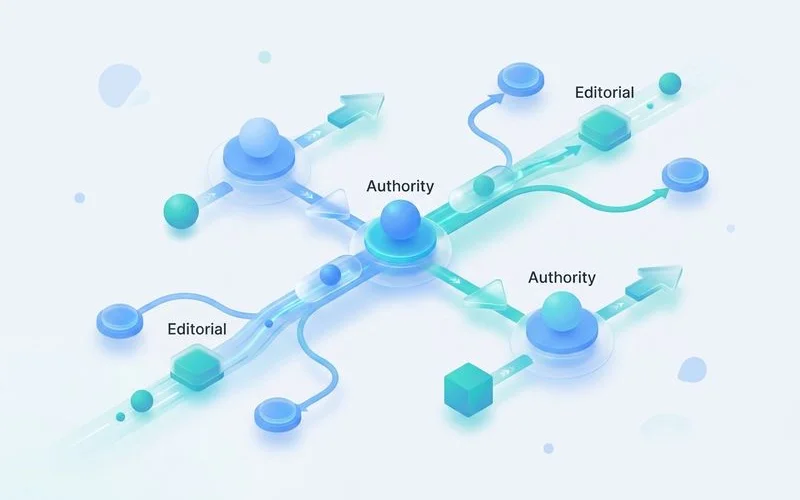
Our process begins by filtering pages through strict performance metrics. A 2026 Shopify Malaysia study discovered that URLs with 40 to 44 internal links frequently generate four times more traffic than pages with fewer connections. Random placement will not yield these results.
You must focus on concrete signals to find the right source pages. To find these high-value source pages, look directly at your Search Console data. The most reliable indicators of authority include high impression counts, strong click-through rates, and average positions in the top ten.
We recommend sorting your existing content into three distinct tiers to streamline your workflow. This framework holds up across multiple customer engagements and prevents wasted effort.
Source Page Authority Tiers
- Tier 1 (High Authority): Pages ranking in positions 1-5 with high daily clicks.
- Tier 2 (Striking Distance): Pages ranking in positions 6-15 that have high impressions but need a slight push.
- Tier 3 (New Content): Recently published pages with zero authority that desperately need internal support.
Anchor-text suggestion logic
Anchor-text suggestion logic matters because it directly controls the topical relevance passed to your target page. Treat this specific text selection as a strict quality gate rather than a simple checkbox.
Our team analyzes search data constantly, and the way algorithms read link text has changed dramatically. A 2026 search industry analysis by SEO Clarity advises keeping exact-match anchor text below 10 percent of your total link profile. Over-optimizing with the same exact phrase repeatedly triggers spam filters and actively harms your rankings.
You should distribute your anchor types naturally to build a credible, penalty-free architecture. The healthiest profiles rely heavily on partial-match variations that blend context and keywords perfectly.
Best Practices for Anchor Text Distribution
To maintain a natural profile, follow these target ratios for your internal links:
- Partial Match (25% to 35%): Include your target keyword alongside descriptive filler words.
- Descriptive Context (40% to 50%): Use natural phrases that describe the destination without explicitly matching the primary keyword.
- Exact Match (5% to 10%): Use the exact target phrase sparingly for maximum impact.
- Branded or Navigation (10%): Utilize company names or natural calls to action.
We enforce these ratios strictly within PowerLinker to ensure safe, scalable growth. This logical distribution keeps your site protected from algorithmic penalties while still passing massive ranking power.
Batch insertion across multiple sources
Batch insertion across multiple sources represents the operational layer where theory turns into actual traffic. This process allows you to update dozens of high-authority pages simultaneously with highly relevant contextual links.
Our clients often waste hours manually digging through old posts to find placement opportunities. The global SEO software market is expanding to an estimated $97.7 billion in 2026 precisely because manual optimization is no longer sustainable. You need an automated system to handle the heavy lifting.
The standard pattern remains consistent regardless of your specific stack. First, you identify the input pages, run the insertion process, validate the final output, and then iterate based on indexing results.
Manual Processing vs. Automated Insertion
To illustrate the efficiency gains, compare the traditional approach with an automated system like PowerLinker.
| Workflow Stage | Manual Link Building | PowerLinker Batch Insertion |
|---|---|---|
| Source Discovery | Requires hours of manual site searches and spreadsheet tracking. | Instantly identifies top GSC pages with matching contextual relevance. |
| Anchor Text Creation | High risk of repetitive, over-optimized exact match text. | Automatically suggests safe, varied partial-match phrases. |
| Execution | Requires opening and editing each individual post. | Deploys multiple links across the entire site with a single click. |
We highly recommend moving away from manual editing once your website surpasses fifty published articles. The time saved through batch processing can be redirected into creating high-quality, conversion-focused content.
Additional considerations
Several critical tracking factors demand your attention as you implement this internal linking architecture. Measuring the direct impact of your updates ensures your strategy actually moves the needle on traffic.
Our data indicates that 58.5% of Google searches now end without a click to external websites, according to a 2026 GoodFirms report. Capturing the remaining commercial intent requires a flawless user experience and deep technical health.
As you work through this process, monitor these specific elements closely:
- Crawl Depth Improvements: Check your Google Search Console Crawl Stats to confirm search engine bots are reaching your newly linked pages faster.
- Audit Trail and Rollback: Always maintain a clear record of your link insertions so you can reverse changes if rankings drop unexpectedly.
- Avoiding Over-Optimization Signals: Monitor your anchor text ratios constantly to prevent algorithmic penalties from exact-match repetition.
- Bounce Rate Shifts: Watch your analytics to ensure visitors are actually clicking the internal links and staying on your website longer.
We treat internal linking as an ongoing maintenance task rather than a one-time project. Your website architecture must adapt continuously as you publish new content and user search behaviors shift.
What to do next
The natural next step is to put this proven strategy into practice immediately with the GSC Action Center. If your current workflow feels slow or disconnected, this tool will bridge the gap.
We structured the underlying feature around exactly the workflow described above. By integrating your Google Search Console data directly, you eliminate the guesswork from your site architecture planning.
Start by identifying three high-value target pages that need a traffic boost right now. Run them through the batch insertion process, and monitor the results over the next thirty days.