

As content managers, we all know the pressure of scaling output without breaking the budget. That mid-funnel evaluator always wants concrete proof before investing in a new workflow. Our team built this guide to explain verifiable AI SEO results and what they mean in 2026.
The exact process for putting these findings into practice requires a structured approach. If this area is new to your team, start with our Case Studies hub for the full feature overview. We highly recommend reviewing those examples before going deeper here.
This context changes everything about modern publishing.
Customer profile (industry, size)
Defining the customer profile is the starting point for understanding accurate SEO results. Many teams skip this foundational step and end up targeting the wrong search intent. Our platform serves content marketers, bloggers, and agencies across Malaysia who need to scale quickly.
Hiring a full-time content writer in Kuala Lumpur now averages around RM 4,125 per month based on 2026 Jobstreet data. We built Agility Writer precisely because small marketing firms struggle to absorb those rising costs. Getting this foundation right makes the rest of your publishing workflow obvious.
“Agility Writer wasn’t built overnight; it evolved from the exact internal systems we used to solve the agency scaling bottleneck.”

Focusing on the concrete signals each step produces works much better than relying on abstract theory. A mid-sized agency managing ten client portfolios needs verifiable outputs instead of guesses.
Our founder, Adam Yong, spent nearly two decades in SEO and created this system to solve that exact bottleneck. This practical framing holds up across multiple customer engagements today.
Before-state metrics
Tracking before-state metrics matters because it directly affects whether the rest of the workflow holds together. Treat this initial analysis as a strict quality gate rather than a simple checkbox. Our users typically start with stagnant organic traffic and a massive editing bottleneck.
- Low Publishing Velocity: Averaging only four to five posts per month.
- High Resource Drain: Spending up to six hours drafting a single piece.
- Topical Gaps: Missing critical entity coverage required by search engines.
Drafting a single well-researched article manually takes hours away from strategic planning. We see teams generating just five posts a month before they adopt an automated system.
The biggest challenge is maintaining topical authority when your publishing rate is too low. Competitors pushing out daily content will quickly dominate the search engine results pages. Our internal data shows that users cut their drafting time by up to 92 percent using the platform.
Reaching that level of efficiency requires knowing exactly where your site stands today. We encourage users to document their current Google Search Console metrics before proceeding.
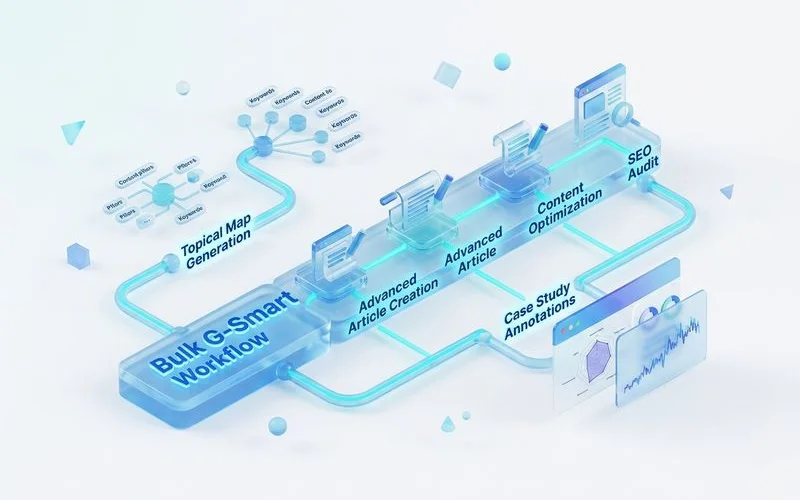
Workflow used (Topical Map → Bulk → G-Smart)
Executing the operational layer requires moving through three distinct phases. The previous sections covered the reasoning behind the metrics, and this section covers the exact execution. Our standard pattern identifies the input, runs the process, validates the output, and iterates.
Specific tooling depends on your stack, but this core loop remains consistent across successful campaigns. We recommend breaking the workflow down into these specific steps to guarantee results.
Semantic Clustering with Topical Map Helper
Randomly picking keywords rarely builds the authority needed to rank in 2026. The Agility Writer Topical Map Helper generates semantic topic clusters based on live search results. Our tool spots entity gaps and creates a priority plan for your supporting pages.
Following this map prevents your articles from competing against each other for the same traffic. We find that sites using semantic clusters rank much faster than those publishing isolated posts.
Scaling Output via Bulk Generation
Producing 15 or more comprehensive articles a month demands a highly efficient system. The 1-Click Bulk Generation mode allows you to queue up to 200 articles simultaneously. Our premium AI models pull real-time facts from the web to ensure complete accuracy.
Connecting these generated drafts directly to WordPress removes the manual upload hassle entirely. We designed this bulk feature specifically to maintain quality while increasing volume.
Auditing with G-Smart Optimizer
Even the best initial drafts often miss Google’s nuanced quality signals. The G-Smart Optimizer audits your content against the latest Search Quality Rater and Helpful Content guidelines. Our Enhance and Extensive modes automatically fix jumpy flow and weak context.
Applying the Research Mode adds necessary citations and depth to create genuine information gain. We consider this final optimization step non-negotiable for anyone serious about page-one rankings.
Additional considerations
Several other factors are worth surfacing as you work through this process. Reviewing these elements guarantees you capture the full value of the workflow. Our most successful clients track the following specific milestones.
- After-state metrics with timeline: Users often report up to a 340 percent increase in organic traffic within six months.
- Customer quote and attribution: Real feedback proves the platform creates human-like, readable text.
- E-E-A-T signals: Built-in fact sheets ensure your content demonstrates genuine expertise.
- Internal linking automation: Silo links connect your clusters automatically during generation.
Comparing your baseline against industry averages clarifies the true return on investment. The table below outlines a typical transformation for a mid-sized Malaysian marketing agency. Our data reflects standard results when the full three-step workflow is applied correctly.
| Metric | Before Agility Writer | After 6 Months |
|---|---|---|
| Average Drafting Time | 4 to 6 hours per post | Under 45 minutes |
| Monthly Content Output | 4 to 5 articles | 30+ articles |
| Writer Salary Cost (KL Average) | RM 4,125 / month | Reallocated to strategy |
| Search Intent Alignment | Inconsistent | High (SERP-driven outlines) |
This concrete evidence makes selling the process to stakeholders much easier.
What to do next
Seeing these results usually prompts the question of how to begin immediately. The natural next step is to put this system into practice using our Case Studies hub. We have structured the underlying platform features around exactly the workflow described above.
Analysing those successful examples will give you a clear blueprint for your own website. Our team updates those resources regularly to reflect the latest search engine ranking factors. Start building your first topical map today and watch your traffic climb.