
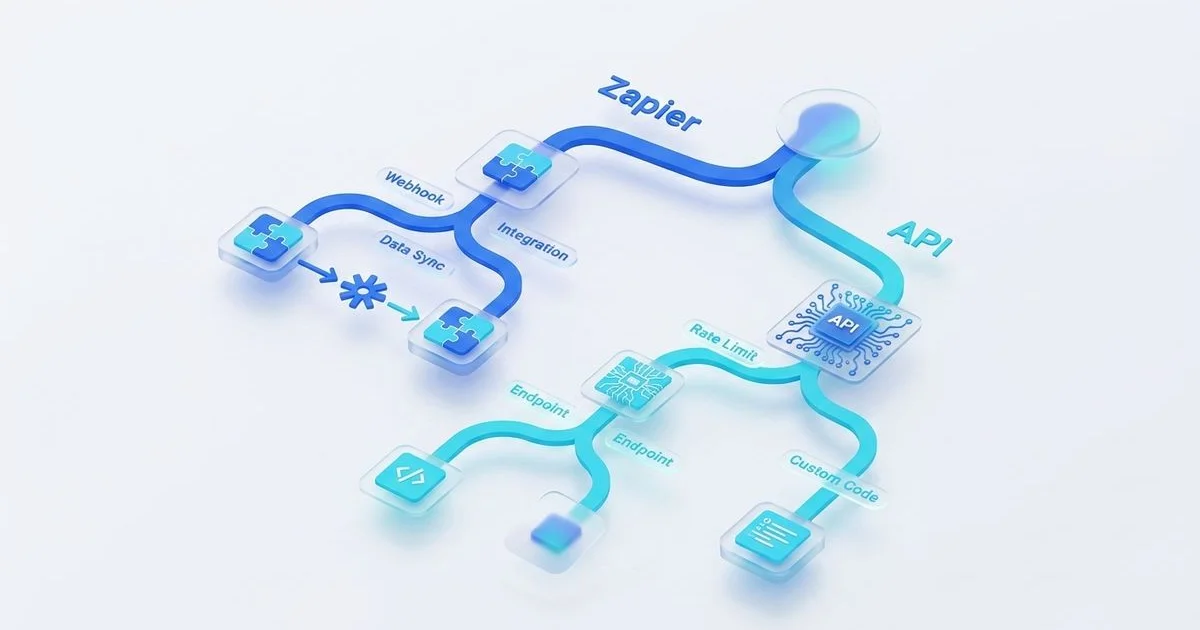
We notice many SEO teams hitting a wall when scaling content production across platforms. Building an automated pipeline forces a critical choice between no-code convenience and custom code control for the api vs zapier ai writer setup.
Our founder Adam Yong spent nearly two decades in SEO facing these exact technical bottlenecks.
The financial data highlights how quickly monthly task limits drain marketing budgets. We designed this guide to break down the cost structures, technical requirements, and migration paths for both methods.
You will learn exactly when to stick with visual builders and when custom code becomes necessary.
If you are new to programmatic content, start with our API Integration hub for the full feature overview before going deeper here. Data shows us the clear path forward.
When Zapier is enough
We recommend sticking with Zapier if your content operation publishes under 750 articles per month and relies on standard platforms. The visual editor makes setting up an agility writer api or zapier connection quick without writing a single line of code.

Our entry-level Basic plan, starting at $28 per month, fully supports this integration. Most teams skip this step and pay for it later, but getting the foundation right makes the rest of the workflow obvious.
The Zapier Free tier gives you 100 tasks monthly. This allowance caps out fast because each article generation requires multiple system actions.
Upgrading to the Professional plan for $29.99 per month (roughly RM 140 in Malaysia) increases this limit to 750 tasks.
We suggest focusing on the concrete signal each step produces, not the abstract theory. Your team can easily configure a Google Sheet trigger to generate a full article and push it directly to WordPress.
Here are the key metrics that indicate Zapier is your best route:
- Monthly Task Volume: Your publishing schedule stays comfortably under the 750-task threshold.
- Team Skillset: Your marketing department lacks dedicated Python or Node.js developers.
- Platform Support: You rely on standard Content Management Systems like Shopify or Webflow.
- Setup Speed: You need a functional content pipeline running by the end of the day.
Assessing the api vs zapier ai writer costs
Our clients often hit a performance ceiling when their organic traffic strategies demand high-volume production. Zapier charges a 1.25x premium on your average task cost if you exceed your monthly allowance through pay-per-task billing.
This financial penalty turns a cheap automation setup into an expensive liability. We have seen campaigns stall entirely because an account reached its task limit and the automations paused.
When API earns its complexity
Moving to a direct API connection makes sense when you need to bypass third-party task limits and generate massive content batches. The technical upgrade matters because it directly affects whether the rest of the workflow holds together.
Our REST API handles bulk generation requests of up to 200 articles in a single run. Developers use this direct connection to request advanced SEO features, including competitor-based smart outlines and built-in citation support.
Custom code gives you total control over the data payload. We treat this as a quality gate, not a checkbox.
Standard third-party connectors often rely on 15-minute polling intervals to check for new data. Direct endpoints eliminate this delay entirely with instant webhooks that fire the moment a draft finishes.
Here is a clear comparison of the two approaches:
| Feature Category | Standard Zapier Connection | Direct API Integration |
|---|---|---|
| Volume Limits | Restricted by monthly subscription tasks | Up to 200 articles per bulk request |
| Execution Speed | Subject to 2-minute or 15-minute polling delays | Instant data transfer via webhooks |
| Financial Overhead | Subject to 1.25x pay-per-task overage fees | Included within your active credit balance |
Plan-tier requirements
Your chosen automation method dictates which specific software license you need to purchase. The previous sections covered the why; this one covers the how.
Our Basic plan supports simple app integrations but restricts programmatic access. You must secure a higher tier to generate the authentication keys needed for custom server scripts.
The standard pattern is consistent across all setups. Marketing operations must identify the input, run the process, validate the output, then iterate.
We structure our pricing to scale alongside your organic search growth. The Pro plan costs $98 per month and includes 150 writing credits.
This tier serves as the mandatory entry point for developer access. Agencies managing multiple client portfolios typically require the Premium plan, which provides 380 credits for $228 per month.
Specific Tooling for the Developer Loop
Our system processes requests similarly regardless of whether you write in Python, PHP, or JavaScript. The development cycle requires sending a POST request with your target keywords and reading the JSON response.
Many technical marketers use Make.com as a powerful middle ground. This platform offers visual building blocks but handles JSON payloads and direct HTTP requests much better than basic automation tools.
Additional considerations
Two major factors often catch marketing teams off guard when scaling up. Several other factors are worth surfacing as you work through this ai writer integration choice.
Our support desk frequently fields questions about hidden subscription stacking and technical debt. You must analyze your total monthly operating expense before committing to a system architecture.
- Cost comparison (Zapier seat + Agility Writer plan vs Pro+): Stacking a $103.50 Zapier Team plan with our $28 Basic tier costs over $131 monthly. Upgrading directly to our $98 Pro plan provides full developer access and 110 additional writing credits for less money.
- Migration path Zapier → API: Transitioning systems requires careful planning to prevent publishing downtime. Teams should run their new Python or Node.js scripts in a staging environment while keeping their visual Zaps active as a fallback.
- Rollover Credit Protection: Unused credits carry forward to the next month on all our paid plans. This protects your budget during slow publishing periods.
What to do next
The clearest path forward requires auditing your current monthly content volume and technical resources.
If this guide matched your situation, the natural next step is to put it into practice with API Integration. Our engineering team structured the underlying feature around exactly the workflow described above.
Developers can move directly to implementation once the project scope is defined. We see most users configuring their first test call in under fifteen minutes.
Your future content velocity depends on making the right api vs zapier ai writer infrastructure choice today.