The Spring 2026 Content Refresh Checklist for HCU-Hit Sites
April is the cleanest window of 2026 to run a content refresh — the spring core update window has closed and indexation is back to baseline. Here's the G-Smart-aligned refresh checklist we run on internal sites.
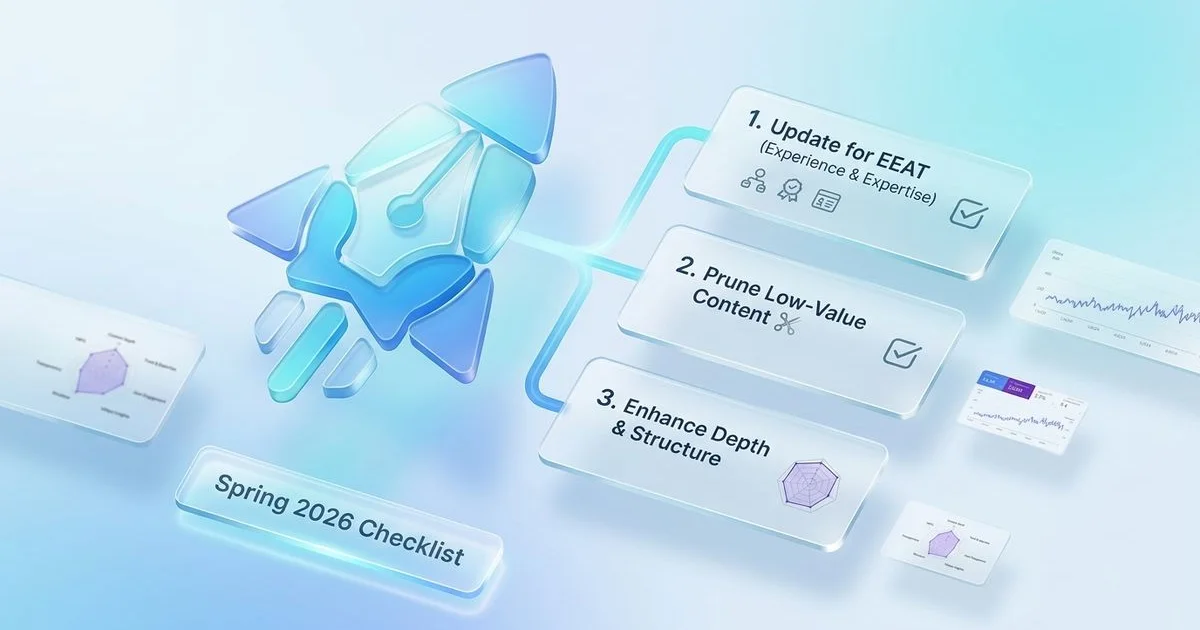
Most teams know they should refresh content. Few actually run it on a cadence. Spring 2026 is a cleaner refresh window than usual, and worth the time block.
Why April 2026 is a good window
Google’s spring 2026 core update finished rolling out in late March. Indexation has stabilized; rank fluctuation is low. April is the first window in 2026 where:
- Pages dropped during the spring update have settled at their new positions
- New rankings won’t be confused with core update volatility
- You can measure refresh impact cleanly
If your site dropped during the update, this is the window to act. If your site survived, this is still the cheapest cluster-level lift you’ll get all year.
The 60-minute refresh checklist
Here’s the checklist we run on internal sites and on customer audits. Allocate one hour and you’ll cover the most impactful 5–10 pages.
Step 1: Pull the priority list (10 min)

Open GSC Action Center (or GSC directly if you’re not on Pro). Filter to:
- Position 5–20
- Impressions > 500/month
- Click-through-rate < 2%
These are pages where small lifts produce big traffic. Take the top 10.
Step 2: Run G-Smart on each page (5 min per page)
For each page in the priority list:
- Paste the URL into G-Smart Optimizer
- Review the entity coverage gaps and Information Gain score
- Apply the suggested rewrites in-place
Tip
Don’t accept every suggestion. G-Smart errs toward thoroughness; you’ll occasionally see suggestions that are correct in isolation but break the article’s flow. Skip those.
Step 3: Update the dateModified (1 min per page)
This is small but matters. After republishing, update the article’s dateModified schema markup to today’s date. Google looks at content freshness as a re-crawl signal.
Step 4: Internal-link audit (5 min per page)
Check that 2–3 high-authority pages on your site link to the refreshed page with descriptive anchor text. If not, use PowerLinker to surface candidate source pages.
Step 5: Re-submit to GSC (1 min per page)
Use the URL Inspection tool to request indexing. Don’t skip this — Google’s natural recrawl can take weeks for older pages.
What changes after the refresh
| Signal | Typical timing |
|---|---|
| Re-indexation | 1–7 days |
| First ranking movement | 7–21 days |
| Stable new position | 30–60 days |
Don’t over-monitor in week 1. Rankings bounce while Google reassesses.
What not to refresh
Some pages should be left alone:
- Articles ranking position 1–3 — refresh risks the position you have
- Pages with sub-100 monthly impressions — fix the underlying topic gap, not the page
- Time-sensitive content (news, events) — refreshing doesn’t help; sunset and replace
- YMYL topics (medical, legal, financial) — manual editorial review beats AI rewrites
The refresh cadence we recommend
For most sites: quarterly refresh of the top 50 pages, plus opportunistic refreshes after core updates. Annual refreshes are too slow; monthly refreshes burn budget on diminishing returns.
Want G-Smart’s full audit pipeline? Start your $1 trial — five credits is enough to refresh 2–3 articles end-to-end before subscribing.

Adam Yong
Founder & CEO, Agility Writer
SEO professional and consultant since 2011. 15+ years of practical SEO experience baked into Agility Writer's methodology.
✓ SEO professional since 2011 · Founder & CEO of Agility Writer