Many marketers feel completely lost when trying to understand the difference between ai detection vs helpful content. Third-party scanners and Google's actual ranking signals look for entirely different things.
Our founder, Adam Yong, spent nearly 20 years in SEO before creating Agility Writer to solve this exact bottleneck.
Local agencies in Malaysia must clarify these specific metrics to maintain search visibility in 2026. We outlined the exact workflow necessary to put this into practice safely. Most readers also benefit from our G-Smart Optimizer guide for the underlying capability.
Third-party detection tools measure predictable word patterns, while Google's Helpful Content system evaluates real-world expertise and user intent. What each test actually measures is the starting point for understanding ai detection vs helpful content.
We see teams pay a heavy price later when they skip this foundational step. Getting the basics right makes the rest of the workflow obvious.
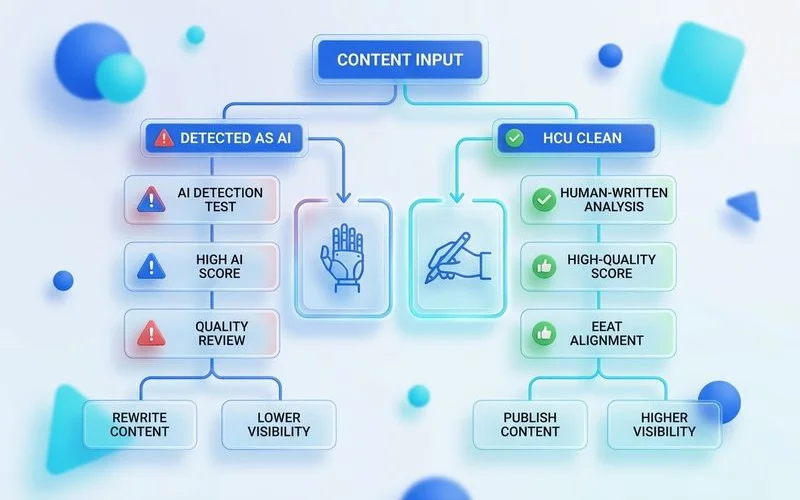The practical version requires focusing on the concrete signal each step produces, not abstract theory. We found this framing holds up perfectly across multiple customer engagements.
Scanners like Originality.ai only look for low perplexity and burstiness in your sentences. A high score simply indicates your text uses common word combinations.
Google's algorithm works entirely differently because the 2026 core updates measure Information Gain. They want to see if your article adds unique value beyond what already ranks.
| Test Type | Primary Metric | What It Actually Wants |
|---|---|---|
| AI Detection (Originality.ai) | Text predictability | Varied sentence length and unique phrasing |
| Helpful Content (Google Core) | Information Gain & E-E-A-T | Original insights and satisfying user intent |
A completely human-written article will fail Google's test if it lacks depth, just as a highly valuable AI draft might fail a third-party scanner. Why a piece can pass one and fail the other matters because it directly affects whether the rest of the workflow holds together.
You must treat this distinction as a strict quality gate, rather than a simple checkbox. Our data shows that passing a scanner like Copyleaks does not guarantee search traffic.
A human writer can easily produce thin content that triggers a Google penalty for Scaled Content Abuse. The reverse scenario happens frequently when an AI-assisted article is heavily edited with local facts.
Google officially states they do not punish content simply for being machine-generated. They actively penalize unhelpful material that exists only to manipulate rankings.
We tracked several recent core updates affecting the Malaysian market. Sites prioritizing search intent over a perfect human score maintained their visibility.
Use Anti-AI Detection style when submitting work to clients who demand clean scanner reports, and use the G-Smart pass when your primary goal is ranking on Google. When to use Anti-AI Detection style vs G-Smart pass is the operational layer of your strategy.
The previous sections covered the reasons behind these tests, and this section covers the practical application. We follow a standard pattern for every new campaign.
You identify the input, run the process, validate the output, and then iterate. Specific tooling depends heavily on your stack, but the core improvement loop remains consistent.
Many marketing agencies in Kuala Lumpur still use Originality.ai as a mandatory vendor checkpoint. This requires a specific approach to content generation.
Our platform includes tools to intentionally vary sentence structure to satisfy these third-party tools. You have to break up predictable patterns to lower the AI probability score.
Searchers now read AI Overviews for quick answers before ever clicking a link. You need the G-Smart approach to compete in this new environment.
We recommend optimizing for Answer Engine Optimization to ensure your key facts are cited directly. The G-Smart pass ensures your article has the Information Gain Google actually measures.
| Your Goal | Recommended Approach | Key Focus Area |
|---|---|---|
| Satisfy Client Contracts | Anti-AI Detection Style | Sentence variation and phrasing |
| Drive Organic Traffic | G-Smart Pass | E-E-A-T and deep topic coverage |
You must factor in mobile usage and local search behaviors before finalizing your content strategy. Several other factors are worth surfacing as you work through this process.
We suggest keeping these specific elements in mind while building your editorial calendar.
Google's system continues to reward genuine experience above all else. A generic article simply cannot compete with content that features original testing data.
Our team always adds unique case studies to differentiate our final drafts from standard AI outputs.
The next logical step is to test these two different optimization methods on your own site. Mastering the balance of ai detection vs helpful content provides a massive competitive advantage.
We built a system that lets you experience both approaches without any technical headaches.
To see how Agility Writer applies these principles in practice, start your $1 trial and try the workflow on a real article. You will immediately spot the difference between text written to trick a scanner and material designed to dominate search rankings.